
High-risk payments guide
What Is a Good Chargeback Ratio?
A good chargeback ratio stays under 1%, and ideally below 0.5%, well clear of the card-network thresholds that trigger fines and termination.
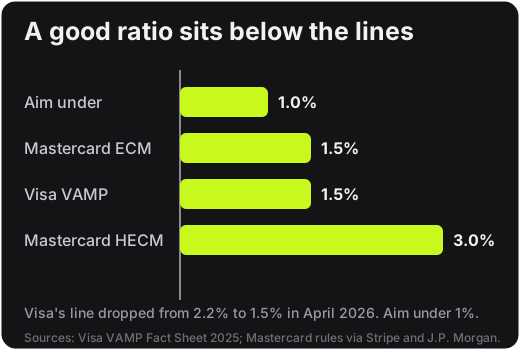
A good chargeback ratio sits under 1%, and ideally below 0.5%. That is the working benchmark for a healthy merchant account, and it is well below the lines the card networks draw. Visa now flags merchants at 1.5%, lowered from 2.2% in April 2026, so “good” is not about scraping under the limit. It is about leaving enough room that a bad month never puts you in danger. For a high-risk business, that buffer is the difference between an account that runs quietly and one that draws a reserve.
Key takeaways
- A good chargeback ratio is under 1%, and below 0.5% is the target for a healthy high-risk account. The ratio is chargebacks divided by transactions, counted monthly.
- Visa’s monitoring program now flags merchants at a 1.5% ratio, lowered from 2.2% in April 2026, measured as fraud plus disputes over settled online sales (Visa, VAMP Fact Sheet, 2025).
- Mastercard’s excessive programs start at a 1.5% ratio and escalate to 3.0% for the high-excessive tier (Stripe and J.P. Morgan, 2025).
- The ratio is the number your processor watches. Cross the thresholds for long and the costs are fines, a rolling reserve, and termination.
What counts as a good chargeback ratio?
A good chargeback ratio is anything under 1%, and the strongest accounts run below 0.5%. There is no single official “good” number published by the networks, because they only publish the bad ones, the thresholds where monitoring kicks in. So the practical benchmark works backward from those limits. Visa’s excessive line now sits at 1.5%, lowered from 2.2% in April 2026 (Visa, VAMP Fact Sheet, 2025), and Mastercard’s excessive program starts at 1.5%. Stay under 1% and you have a real cushion. Hold under 0.5% and you are comfortably clear.
Why does the gap matter? Your ratio is not a steady number. A single dispute-heavy month, a product issue, or a fraud spike can push it up fast, and the networks measure month by month. If your normal ratio is 1.4%, one bad week can tip you over a threshold. If it is 0.4%, the same bad week barely registers. A good ratio is really a safety margin, not a score.
How is a chargeback ratio calculated?
You calculate a chargeback ratio by dividing your chargebacks by your transactions over the same period, then multiplying by 100 to get a percentage. The standard period is one calendar month, and most card-network programs count by the number of transactions, not the dollar value.
Here is a worked example. Say you process 5,000 transactions in a month and receive 20 chargebacks. That is 20 divided by 5,000, which is 0.004, or 0.4%. A healthy ratio. Now say a fraud ring hits you and chargebacks jump to 75 on the same 5,000 sales. That is 75 divided by 5,000, or 1.5%, and you have just crossed into Mastercard’s excessive range and reached Visa’s current excessive line.
One detail trips merchants up. The count is usually current-month chargebacks over current-month transactions. Some programs measure chargebacks against the prior month’s sales, which matters if your volume swings. The takeaway is to track the ratio the way your processor does, not a version you invented, because that is the number that decides whether you get a warning letter.
What chargeback thresholds do Visa and Mastercard set?
Visa and Mastercard each run their own monitoring programs with their own thresholds, and they tightened in 2025. In June 2025 Visa folded its older fraud and dispute programs into one Visa Acquirer Monitoring Program (VAMP). It measures fraud plus disputes against settled transactions on online sales. The excessive-merchant line is now a 1.5% ratio with at least 1,500 monthly events, lowered from 2.2% in April 2026 (Visa, VAMP Fact Sheet, 2025).
Mastercard runs a parallel structure. Its Excessive Chargeback Merchant (ECM) program starts at 100 to 299 chargebacks a month combined with a ratio between 1.5% and 2.99%. Its High Excessive Chargeback Merchant (HECM) tier begins at 300 chargebacks and a 3.0% ratio. Separately, Mastercard’s Excessive Fraud Merchant program watches fraud on its own, triggering at 1,000+ ecommerce transactions, more than $50,000 in fraud, and a fraud ratio of 0.5% or higher (Stripe and J.P. Morgan, 2025). Here is how the lines compare.
| Program | Threshold ratio | Volume trigger | What it measures |
|---|---|---|---|
| Visa VAMP (excessive) | 1.5% (from 2.2% in April 2026) | 1,500+ monthly events | Fraud plus disputes / settled online sales |
| Mastercard ECM | 1.5% to 2.99% | 100 to 299 chargebacks/month | Chargebacks / transactions |
| Mastercard HECM | 3.0% and above | 300+ chargebacks/month | Chargebacks / transactions |
| Mastercard EFM | 0.5%+ fraud ratio | 1,000+ ecommerce sales, $50k+ fraud | Fraud only |
Notice that these are the alarm bells, not the targets. A “good” ratio lives far below the lowest of them. And the volume triggers matter. A tiny merchant with three chargebacks on 50 sales has a 6% ratio but may not hit a program’s minimum event count, while a large merchant trips the count long before a small one does.
What is the difference between a dispute ratio and a fraud ratio?
A dispute ratio counts every chargeback against your transactions; a fraud ratio counts only the fraud-coded ones. The split matters because the networks watch them differently. A customer who says “I never authorized this” creates a fraud chargeback. A customer who says “the product never arrived” or “this is not what I ordered” creates a non-fraud, or dispute, chargeback. Both raise your overall ratio, but only the first lands in a fraud bucket.
Visa’s current program blends them, measuring fraud plus disputes together over settled online sales. Mastercard keeps them more separate. Its chargeback programs count total disputes, while its Excessive Fraud Merchant program isolates fraud at a 0.5% line. The practical point is that you cannot manage one number and ignore the other. You can have a clean dispute ratio and still fail a fraud threshold, or pass on fraud and drown in product complaints. A good account keeps both low, which means fewer fraud losses and fewer service problems, not just one or the other.
How do you keep your chargeback ratio low?
You keep a chargeback ratio low by stopping disputes before they are filed and refunding the ones you would lose anyway, because a chargeback already counted stays on your ratio even when you win it. Prevention is the only lever that touches the number directly, since once a dispute hits the network it is recorded regardless of the outcome.
A few habits do most of the work:
- Make refunds easy and fast. A customer who can get their money back from you has no reason to call their bank. A refund issued before a chargeback is filed never touches your ratio.
- Bill clearly. A recognizable billing descriptor cuts “I don’t recognize this charge” disputes, one of the most common reason codes.
- Use dispute alerts. Visa and Mastercard run alert networks (Verifi, Ethoca) that flag a brewing dispute so you can refund first. Vendors report they prevent a significant share of disputes, though the specific percentages are their own figures.
- Watch your ratio weekly, not monthly. The networks measure monthly, but if you only check monthly you find out you crossed a line after it is too late to fix.
- Fight the disputes worth fighting. First-party fraud, where a real customer disputes a purchase they made, runs to about 21% of chargebacks in Mastercard’s 2025 data. Those are worth fighting with evidence.
The cost of getting this wrong is not just the ratio. US merchants lose about $4.61 for every $1 of fraud once fees, lost goods, and labor are counted (what a dispute really costs; LexisNexis, 2025), and what you pay to process and to dispute is part of your overall high-risk pricing. A structured defense, prevention before the sale, alerts during, and evidence when a case is worth it, is what chargeback management exists to provide. If the line between a chargeback and a refund is still fuzzy, the difference between a chargeback and a refund is worth a read first.
The number worth defending
A good chargeback ratio is under 1%, and below 0.5% if you want room to breathe. That is not where the card networks draw the line; it is where a careful merchant chooses to live so the line never becomes a threat. Calculate it the way your processor does, watch it more often than they do, and treat every avoided dispute as margin against the bad month that eventually comes. For a high-risk account, the ratio is the single number that decides whether your processing stays quiet or starts costing you reserves. Keep it low and you keep control.
Frequently asked questions
- What is considered a good chargeback ratio?
- Under 1% is the working benchmark, and below 0.5% is where you want to be for a healthy account. The card networks act before that. Visa's monitoring program now flags merchants at 1.5%, lowered from 2.2% in April 2026, so good means staying far below the line.
- How is a chargeback ratio calculated?
- Divide your chargebacks by your transactions over the same month, then multiply by 100. Twenty chargebacks on 5,000 sales is a 0.4% ratio. Most card-network programs count by number of transactions, not dollar value, and measure it monthly.
- What is the difference between a dispute ratio and a fraud ratio?
- A dispute ratio counts all chargebacks against transactions. A fraud ratio counts only the fraud-coded ones. Visa's program now blends both, measuring fraud plus disputes over settled online sales, while Mastercard's Excessive Fraud Merchant program watches fraud separately at a 0.5% line.
- What chargeback ratio gets your account terminated?
- Sustained breaches do, not a single bad month. Mastercard's High Excessive tier starts at a 3.0% ratio with 300+ chargebacks, and prolonged time in any excessive program can bring fines, a rolling reserve, then termination, which can place a business on the MATCH list.
- Does refunding a customer lower your chargeback ratio?
- Only if you refund before the chargeback is filed, because a chargeback already counted stays counted even if you later win it. Refunding early keeps the dispute off your ratio entirely, which is why Visa and Mastercard run alert networks that flag a brewing dispute first.