
High-risk payments guide
Chargeback vs Refund: What's the Difference?
Both send money back to a customer, but only one quietly puts your merchant account at risk. Here is the difference that actually matters for high-risk businesses.
A chargeback and a refund both send money back to a customer, but they are not the same transaction, and the difference decides how much control you keep over your own revenue. A refund is a credit you choose to issue. A chargeback is a forced reversal the cardholder’s bank pushes through, often weeks or months after the sale, with a fee attached and a mark against your account. For a high-risk business, that gap is the line between a routine cost and a threat to the merchant account itself.
Key takeaways
- A refund is voluntary and you control it. A chargeback is a forced bank reversal that adds a fee and counts against the dispute ratio card networks watch.
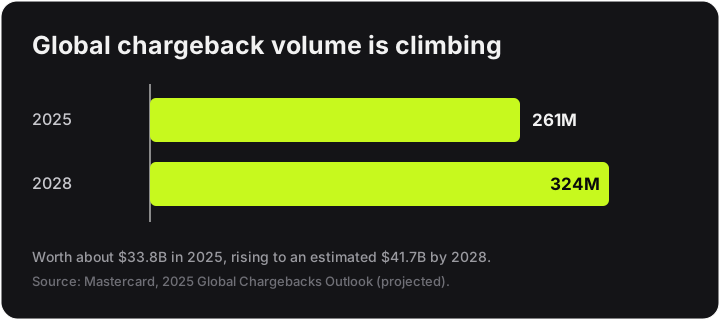
- Global chargeback volume is on track to reach 324 million by 2028, worth an estimated $41.7 billion, up from 261 million in 2025 (Mastercard, 2025 Global Chargebacks Outlook).
- US merchants lose about $4.61 for every $1 of fraud once fees, lost goods, and labor are counted (LexisNexis Risk Solutions, 2025).
- The real danger is not one dispute. It is crossing the Visa and Mastercard monitoring thresholds that bring fines, reserves, and termination.
What is a chargeback?
A chargeback is a payment reversal started by the customer’s bank, not by you. The cardholder disputes a charge, the issuing bank pulls the funds back out of your account, and you are charged a dispute fee on top of losing the sale. These are climbing fast. Mastercard projects global chargeback volume rising from 261 million in 2025 to 324 million by 2028 (Mastercard, 2025 Global Chargebacks Outlook).
The mechanism is what makes a chargeback different from a simple return. It runs on the card networks’ dispute rails, so it carries a reason code, a response deadline, and a paper trail. That record counts against you whether or not you did anything wrong. Even a dispute you eventually win still sits on your account while it is open.
What is a refund?
A refund is a credit you choose to send back to a customer, on your terms and your timing. You set the amount, you keep the record clean, and no dispute fee is charged. Because a refund never touches the dispute system, it does not count against the ratio that decides whether your account stays in good standing.
That control is the whole point. When a customer is unhappy, a refund lets you resolve it directly and quietly. The same complaint, routed through the bank instead, becomes a chargeback: slower, more expensive, and visible to your processor.
Chargeback vs refund: the differences that matter
On a bank statement the two look almost identical. To the business paying the bill they behave very differently. A refund is merchant-controlled and consequence-free. A chargeback is bank-controlled, fee-bearing, and counted against you. The table below sums it up.
| Refund | Chargeback | |
|---|---|---|
| Who starts it | You, the merchant | The cardholder’s bank |
| Timing | Immediate, on your terms | Days to months after the sale |
| Fee | None beyond normal processing | A per-dispute fee, often $15 to $100 |
| Counts against your dispute ratio | No | Yes |
| Effect on the account | Routine | Can trigger monitoring, reserves, or termination |
| Who controls the message | You | The bank |
For a low-risk retailer, the difference is mostly about cost. For a high-risk merchant already watched closely by an acquirer, it is about whether the account survives.
Why does a chargeback cost so much more than a refund?
A chargeback costs far more than the sale because you lose three things at once, then pay to argue about it. In its 2025 True Cost of Fraud study, LexisNexis Risk Solutions found that US businesses lose about $4.61 for every $1 of fraud once fees, lost merchandise, and labor are counted. A refund costs you one thing: the sale.
The fee alone is not small. Processors typically charge $15 to $100 per dispute, and you pay it even when you win. Stack that on the lost goods and the hours spent assembling evidence, and a single $80 order can cost several times its value to fight. What you pay to process, and to dispute, is part of your overall high-risk pricing, which is why an honest quote starts from your real numbers.
Then there is the cost that never shows up on an invoice: your dispute ratio. Every chargeback raises it, and that ratio is what card networks use to decide whether your account is a problem. A structured defense matters here, which is what chargeback management is for: prevention before the sale, alerts during, and dispute response when a case is worth fighting.
How many chargebacks are too many?
Card networks act on ratios, not single disputes, and the thresholds tightened in 2025. In June 2025 Visa folded its older fraud and dispute programs into one Visa Acquirer Monitoring Program, which measures fraud plus disputes against settled transactions on online (card-not-present) sales. The excessive-merchant line sits at a 2.2% ratio paired with at least 1,500 monthly events, and it drops to 1.5% on April 1, 2026 (Visa, VAMP Fact Sheet, 2025).
Mastercard runs a parallel system. Its Excessive Chargeback Merchant program starts at 100 to 299 chargebacks a month combined with a ratio between 1.5% and 2.99%, and the high-excessive tier begins at 300 chargebacks and a 3% ratio (Mastercard rules, as published by Stripe and J.P. Morgan, 2025).
Cross those lines for long and the consequences escalate: fines, a mandatory rolling reserve, or outright termination that can land a business on the MATCH list. If that has already happened, there are still processing options after a MATCH or TMF listing. For an account that may already run close to these ratios, every avoided chargeback is breathing room.
When should you refund instead of fighting?
Refund early when the charge is clearly a satisfaction issue or a low-value dispute you would lose anyway, because a refund issued before the chargeback is filed keeps the case off your ratio entirely. Visa and Mastercard both operate alert networks that flag a brewing dispute so you can refund first, and providers that resell those alerts report they deflect a meaningful share of would-be chargebacks this way.
The math is simple. A refund costs you the sale. A chargeback costs you the sale, the fee, the labor, and a tick on your dispute ratio. When the outcome is the same lost sale either way, the refund is both the cheaper path and the safer one for your account.
The exception is first-party misuse, where a real customer disputes a purchase they actually made. Mastercard’s 2025 data found merchants classified about 21% of their chargebacks as first-party fraud (Mastercard, 2025 State of Chargebacks). Those are worth fighting with evidence rather than conceding. The skill that protects a high-risk account is knowing which dispute is which.
The difference that protects your account
A refund is a decision you make. A chargeback is a decision made for you, with a fee and a record attached. For most businesses that is a cost-control footnote. For a high-risk merchant operating close to the card networks’ monitoring thresholds, it is the difference between an account that keeps running and one that draws a reserve or a termination notice. Keep refunds easy to get, catch disputes early, and treat your chargeback ratio as a number worth defending.
Frequently asked questions
- Is a chargeback the same as a refund?
- No. A refund is money you choose to return to a customer on your own terms. A chargeback is a forced reversal the cardholder's bank processes for them, usually with a per-dispute fee, and it counts against the dispute ratio card networks watch.
- Does refunding a customer stop a chargeback?
- Often, if you act before the dispute is filed. A refund issued early keeps the case off your dispute ratio. Once a chargeback is in progress, refunding can leave you paying twice, so timing is everything. Visa and Mastercard alert networks exist to flag disputes early.
- How many chargebacks are too many?
- Card networks act on ratios, not raw counts. Visa's 2025 monitoring program flags merchants near a 2.2% ratio, dropping to 1.5% in April 2026, and Mastercard's excessive program starts around 1.5%. High-risk accounts should aim to stay well under those lines.
- Why does a chargeback cost more than the sale?
- You lose the product, the payment, and a per-dispute fee of roughly $15 to $100, plus the staff time to respond. LexisNexis puts the true cost of fraud at about $4.61 for every $1 lost in the US once all of that is counted (2025).
- Can too many chargebacks get my account shut down?
- Yes. Sustained breaches of the networks' monitoring thresholds can bring fines, a mandatory rolling reserve, and termination, which can place a business on the MATCH list. That risk is exactly why prevention matters more for high-risk accounts.