
High-risk payments guide
What Is Friendly Fraud?
Friendly fraud is when a legitimate cardholder disputes a valid charge through their bank instead of asking the merchant for a refund. The bank reverses the payment, and unless the merchant fights the chargeback and wins, that reversal costs them the sale, the goods, and a dispute fee.
Friendly fraud happens when a real customer disputes a charge they actually made. The card was theirs, the purchase was legitimate, and they got what they paid for, but instead of asking you for a refund they went to their bank and reversed the payment. It is also called first-party fraud, and it is one of the hardest chargebacks for a high-risk business to see coming, because it does not look like fraud at all until the dispute lands.
Key takeaways
- Friendly fraud is a chargeback filed by a genuine customer on a purchase they really made, whether by honest mistake or on purpose.
- Mastercard’s 2025 data found merchants classified about 21% of their chargebacks as first-party fraud, and vendor estimates run higher but are unsettled (Mastercard, 2025 Global Chargebacks Outlook).
- It is uniquely costly because you lose the sale, the goods, and the dispute fee at once, and it still counts against the ratio card networks watch.
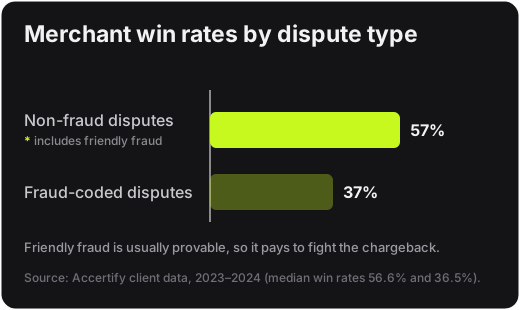
- You can fight it. Friendly fraud is technically considered a “non-fraud” dispute and merchants win them more often than fraud-coded ones, roughly 57% versus 37% (Accertify, 2023–2024 client data).
What is friendly fraud, exactly?
Friendly fraud is a chargeback filed by a legitimate cardholder against a charge they themselves authorized. Nobody stole the card. The order shipped, the service was delivered, the account was used. Then the customer disputed it anyway, and their issuing bank pulled the money back out of your account. The industry’s preferred term is first-party fraud, because the person disputing the charge is the same person who made it, as opposed to a third party using stolen details.
The reason it earns the word “fraud” is the outcome. The customer ends up with both the product and their money back, at your expense. But the label can be misleading. A large share of these disputes are not schemes at all. They are honest confusion, forgotten purchases, or a snap decision to call the bank instead of the merchant. The intent varies wildly from one case to the next. The damage to your account does not.
What causes friendly fraud?
Most friendly fraud traces back to a handful of everyday situations, and only some of them involve any bad faith. The most common triggers are a forgotten subscription that renews, plain buyer’s remorse, a billing descriptor the customer does not recognize on their statement, a claim that an item never arrived when it actually did, and a purchase made by a spouse, partner, or child that the cardholder did not know about.
How each one plays out:
- The forgotten subscription. A free trial converts, or an annual plan renews, and the customer no longer remembers signing up. The charge looks unfamiliar, so they dispute it.
- Buyer’s remorse. The product arrived as described, but the customer changed their mind and finds a chargeback easier than a return.
- The mystery descriptor. Your business name on the card statement does not match the storefront the customer bought from. They do not recognize “NRTH COMMERCE LLC” and assume it is fraud.
- “It never arrived.” The package was delivered, but the customer claims otherwise, sometimes honestly (a porch theft, a confused household) and sometimes not.
- The family purchase. A teenager buys an in-app upgrade, or a partner orders something on the shared card. The cardholder sees a charge they did not personally make and reports it as fraud.
The thread running through all of these is that the customer believes, rightly or wrongly, that the charge is not legitimate. That belief is what turns a routine sale into a dispute.
How common is friendly fraud?
It is common enough to be a top-tier problem for online merchants, though the exact share is genuinely contested. Mastercard’s 2025 data found that merchants classified about 21% of their chargebacks as first-party fraud (Mastercard, 2025 Global Chargebacks Outlook). That alone makes it one of the largest single categories of disputes a business faces.
Plenty of fraud-prevention vendors put the number higher, sometimes much higher. The trouble is those figures are not settled, the definitions differ, and many lean on self-reported merchant surveys rather than network data. So the honest framing is a range, not a headline. At least one in five chargebacks, by the most conservative network-backed measure, and quite possibly more. What is not in doubt is the direction. As overall dispute volume climbs, with Mastercard projecting global chargebacks rising from 261 million in 2025 to 324 million by 2028 (Mastercard, 2025 Global Chargebacks Outlook), the first-party slice grows right along with it.
Why is friendly fraud so costly?
Friendly fraud hits harder than almost any other dispute because you lose three things in a single stroke, then pay to argue about it. The customer keeps the product, the bank takes back the payment, and your processor charges a dispute fee on top. A normal refund costs you one thing, the sale. A friendly fraud chargeback costs you the sale, the goods, and the fee all at once.
The fee is real money. Processors typically charge $15 to $100 per dispute, and you pay it even when you win. Layer on the staff hours spent pulling records and writing a response, and the all-in cost runs well past the order value. In its 2025 True Cost of Fraud study, LexisNexis Risk Solutions found that US ecommerce and retail merchants lose about $4.61 for every $1 of fraud once fees, lost merchandise, and labor are counted.
Then comes the part that never appears on an invoice. Every chargeback, friendly or not, raises your dispute ratio, and that ratio is what card networks use to judge whether your account is a liability. A structured defense is exactly what managing chargebacks is built around, combining prevention before the sale, alerts during the window, and evidence-based response when a case is worth fighting. For a high-risk merchant, an unfought friendly fraud chargeback is not just a lost sale. It is a tick toward a reserve or a termination.
How do you prevent friendly fraud?
You prevent most friendly fraud by removing the confusion that causes it and making a refund easier than a dispute. The customer who recognizes the charge, remembers the purchase, and knows you will help them has no reason to call the bank. The checklist below covers the moves that close the most common gaps.
- Use a clear billing descriptor. Make the name on the card statement match the brand the customer bought from, ideally with a recognizable short tag and a contact number.
- Send subscription reminders. Email customers before a trial converts or a plan renews, so the charge is never a surprise.
- Keep delivery and usage proof. Hold on to tracking, signed delivery confirmation, login timestamps, and IP records. This is your ammunition if you do end up disputing.
- Make refunds easy. A visible, low-friction refund path sends unhappy customers to you first, which keeps the case off your dispute ratio entirely.
- Use dispute alerts. Visa and Mastercard alert networks (Verifi and Ethoca) flag a brewing dispute so you can refund before it hardens into a chargeback.
None of these stop a determined bad actor on their own. But together they shrink the pool of honest-mistake disputes, which is where the bulk of friendly fraud actually lives. Why fight a chargeback you could have prevented with a clearer line on a bank statement?
How do you fight friendly fraud?
When prevention fails, you fight friendly fraud through representment, resubmitting the charge to the issuing bank with compelling evidence that the cardholder authorized it and received what they paid for. This is the one category of dispute where the merchant often holds the stronger hand, because the transaction was real and you can usually prove it. Delivery confirmation, account login records, the IP address used at checkout, and a signed terms agreement all directly contradict a “I never made this purchase” claim.
The odds reward the effort. Non-fraud disputes are won at a higher rate than fraud-coded ones, roughly 57% versus 37% in Accertify’s 2023–2024 client-data benchmark (Accertify, 2025). True fraud is hard to disprove, while friendly fraud often collapses the moment you produce evidence the customer hoped you did not have.
The skill is triage, knowing which disputes carry enough proof to be worth representing, and which low-value cases are cheaper to concede. To see how a forced reversal differs from a credit you choose to give, the breakdown of chargebacks versus refunds is a useful companion.
The dispute that hides in plain sight
Friendly fraud is the chargeback you cannot catch at checkout, because the customer and the card are both genuine. That is what makes it the quiet drain on a high-risk account. It slips past your fraud filters and costs you the sale, the goods, and the fee all at once. On top of that, it pushes your ratio toward the thresholds that draw a reserve or a termination notice. The defense is unglamorous and it works. Make charges recognizable, keep your proof, refund the honest mistakes early, and represent the cases worth winning. Treat first-party disputes as a problem you can measure and manage, not an unavoidable cost of selling online.
Frequently asked questions
- What is friendly fraud?
- Friendly fraud, also called first-party fraud, is when a real customer disputes a charge they actually made instead of asking you for a refund. The card is not stolen and the order is legitimate, but the bank reverses the payment anyway. Mastercard found merchants classified about 21% of their chargebacks as first-party fraud (2025).
- Is friendly fraud illegal?
- Disputing a charge you know is valid to keep both the money and the goods can amount to fraud, but it is rarely prosecuted, and many cases are honest mistakes rather than theft. A customer who forgot a subscription or did not recognize a billing descriptor is not setting out to deceive you. The result on your account is the same either way.
- How common is friendly fraud?
- Mastercard's 2025 data found merchants classified about 21% of their chargebacks as first-party fraud. Some vendors put the share higher, but those estimates vary widely and are not settled, so the honest answer is that it is a large and growing slice of disputes rather than a single fixed number.
- Can you win a friendly fraud dispute?
- Yes, more often than you can win a true-fraud case. Non-fraud disputes are won at a higher rate than fraud-coded ones, roughly 57% versus 37% in Accertify's 2023–2024 client data, because clear evidence like delivery proof and login records directly contradicts the cardholder's claim. The key is submitting compelling evidence through representment.
- How do I prevent friendly fraud?
- Make your billing descriptor recognizable, send subscription renewal reminders, keep delivery and usage records, and offer easy refunds so unhappy customers come to you first. Dispute alert networks like Verifi and Ethoca can also flag a brewing dispute so you can resolve it before it becomes a chargeback that counts against your ratio.