
High-risk payments guide
How to Fight a Chargeback and Win
A chargeback is not automatically a loss. With the right evidence filed on deadline, representment is a fight you can win, but only some disputes are worth fighting.
A chargeback pulls the money back from your account, but it does not have to end there. You have the right to dispute it through a process called representment, where you re-present the transaction to the cardholder’s bank with evidence that the charge was valid. Win, and the funds come back to you. The catch is that representment runs on a tight clock and only succeeds when your evidence directly addresses why the customer disputed. Fight the right cases with the right proof on deadline, and a chargeback becomes a number you can claw back.
Key takeaways
- Representment is the formal dispute process, where you respond to the chargeback’s reason code with evidence, the issuing bank reviews it, and it decides whether to reverse the charge in your favor.
- Win rates depend on the dispute type. Accertify’s 2023–2024 client data puts non-fraud disputes near 57% versus roughly 37% for fraud-coded ones, and net recovery across all chargebacks is much lower.
- Deadlines are short, commonly 20 to 30 days. Miss the date on the notice and you forfeit automatically, regardless of how strong your case is.
- Not every dispute is worth fighting. Mastercard found merchants classified about 21% of chargebacks as first-party fraud (2025); those reward a defense, while low-value satisfaction disputes usually do not.
What is representment and how does the process work?
Representment is the act of disputing a chargeback by sending the transaction back to the cardholder’s bank with proof that the charge was legitimate. It is your formal response, and it moves through a fixed sequence. Knowing each step tells you what to do and when.
- Notification and reason code. Your processor tells you a chargeback was filed and attaches a reason code, a short label such as “product not received” or “fraudulent transaction” that states why the customer disputed. The code defines the entire case. Everything you submit has to address that specific reason.
- Gather strong evidence. You assemble the records that prove the charge was valid for that reason code. This is where most disputes are won or lost, and we cover the strongest evidence below.
- Respond before the deadline. You submit your case and evidence through your processor inside the response window. Miss it and you forfeit, even with a perfect case.
- Issuer decision. The cardholder’s bank reviews your evidence against the dispute and decides. If it sides with you, the chargeback is reversed and the funds return.
- Possible arbitration. If the issuer rejects your case, some networks allow a second round (pre-arbitration and arbitration). This stage carries its own fees and the network makes the final call, so it is reserved for high-value cases you are confident in.
The whole chain hinges on one idea. Match your response to the reason code, and beat the clock. A strong defense at every stage is what dispute management is for, combining prevention before the sale, alerts during, and representment when a case is worth the fight.
What evidence actually wins a chargeback?
Evidence wins when it directly addresses the reason code, not when there is simply a lot of it. A pile of unrelated documents does nothing. One record that answers the exact dispute can flip the case. Match the proof to the claim.
Here is the evidence that carries weight, and the dispute it answers:
- Delivery and tracking proof. Carrier tracking that shows delivery to the cardholder’s address is the single strongest response to a “product not received” claim. Signed delivery confirmation is stronger still.
- AVS and CVV match records. An Address Verification Service match and a CVV match show the buyer had the physical card and knew the billing address, which undercuts a “fraudulent transaction” claim on an online sale.
- Customer communications. Emails, chat logs, or support tickets where the customer acknowledged the purchase, used the product, or agreed to terms can sink a dispute on their own.
- Your terms and refund policy. The policy the customer accepted at checkout, with a timestamp, addresses “I was never told” and “I could not get a refund” arguments.
- Proof of prior legitimate use. A record that the same card made earlier undisputed purchases, or that the customer logged in and used the service, is powerful against a fraud claim from a real buyer.
The pattern is consistent. Tie each piece to the reason code and present it cleanly. An issuer reviewing a stack of files for a few minutes needs to see your response at a glance, not dig for it.
What are the chargeback response deadlines?
Deadlines are short and absolute, commonly 20 to 30 days from the date of the chargeback notice depending on the card network and reason code. There is no partial credit for a late filing. Miss the window and the case closes against you automatically, no matter how complete your evidence is.
That clock is the most common reason merchants lose disputes they should win. The notice can take a few days to surface inside a processor’s dashboard, eating into your window before you have even started. A few habits protect you:
- Treat the date on the notice as a hard line, and build in a buffer rather than filing on the last day.
- Check for new disputes on a fixed schedule, not whenever you happen to log in.
- Keep your evidence organized in advance so assembly takes hours, not days.
If you also operate near the card networks’ monitoring thresholds, speed matters twice over, because a dispute where you missed the deadline still counts against your dispute ratio, the number that decides whether your account draws a reserve or a termination notice.
What are realistic win rates by dispute type?
Win rates are not one number. They split sharply by whether the chargeback is fraud-coded or not. Accertify’s 2023–2024 client data puts non-fraud disputes around 57% and fraud-coded disputes near 37% (Accertify, 2025), and the net recovery across all chargebacks, once you account for cases not worth fighting, is much lower. So the same effort pays off very differently depending on the code you are answering.
Why the gap? Non-fraud disputes (“product not received”, “not as described”, “duplicate charge”) turn on records you usually have, like tracking, the product listing, and the transaction log. Fraud-coded disputes ask you to prove the real cardholder authorized the sale, which is harder to document on an online order even when you did everything right.
First-party fraud is the category that rewards a defense, and Mastercard’s 2025 data puts it at about 21% of chargebacks, where a genuine customer disputes a purchase they actually made. Those cases often have a clear evidence trail, login records, delivery confirmation, prior use, that an honest review will credit. The skill is reading the reason code and your own records before you commit hours.
When is fighting worth it, and when should you refund instead?
Fight when you have evidence that addresses the reason code and the recovery beats the cost of responding; refund or concede when neither holds. Not every dispute is worth the labor, and pretending otherwise just burns staff time you could spend on winnable cases. Be honest about which is which.
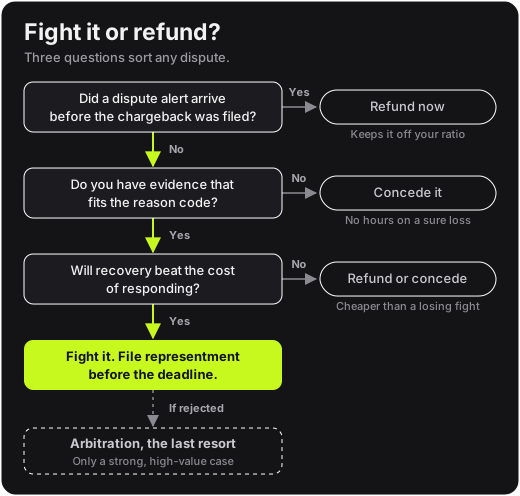
The table below is the same logic as a quick lookup.
| Situation | Better move |
|---|---|
| Strong evidence addresses the reason code (tracking, AVS/CVV, prior use) | Fight it through representment |
| First-party dispute on a purchase the customer clearly made | Fight it with the evidence trail |
| Low-value satisfaction complaint you would likely lose | Refund or concede; do not spend the time |
| Dispute alert arrives before the chargeback is filed | Refund early to keep it off your ratio |
| High-value case the issuer rejected, evidence still strong | Consider arbitration, weighing its fees |
The economics decide it. A lost dispute is never just the sale; counting fees, lost goods, and labor, the true cost reaches about $4.61 per $1 of fraud (what a dispute costs; LexisNexis, 2025). When a refund and a lost fight end in the same lost revenue, the refund is cheaper and, because it keeps the case off your dispute ratio, safer for the account. Visa and Mastercard both run alert networks (Verifi, Ethoca) that flag a brewing dispute so you can refund before it becomes a chargeback at all. The difference between a refund and a chargeback, and when each is the right call, is worth understanding in chargeback vs refund.
There is a ratio reason to be selective, too. Card networks act on thresholds. Visa’s 2025 Acquirer Monitoring Program now flags excessive merchants at a 1.5% ratio, lowered from 2.2% in April 2026 (Visa, VAMP Fact Sheet, 2025), and Mastercard’s Excessive Chargeback Merchant program starts at 100 to 299 chargebacks a month with a ratio between 1.5% and 2.99% (Mastercard rules, via Stripe, 2025). Winning representment recovers funds, but it does not erase the chargeback from your count. That is why prevention and early refunds, not just disputes, keep a high-risk account healthy.
How to win the chargebacks worth fighting
A chargeback is a fight you can win, but only when you pick the right ones and answer them precisely. Read the reason code first, because it dictates everything. Assemble the evidence that addresses that specific claim, delivery proof, AVS and CVV match, customer communications, your terms, prior legitimate use. File inside the deadline with room to spare. Then let the issuer weigh a clean, on-point response. Concede the disputes you would lose and refund the ones you can catch early, so your energy and your dispute ratio both go to the cases that actually pay off.
Frequently asked questions
- What is representment in a chargeback?
- Representment is the formal process of disputing a chargeback by re-presenting the transaction to the cardholder's bank with evidence that the charge was valid. You respond to the reason code with proof, the issuer reviews it, and it decides whether to reverse the chargeback back in your favor.
- What evidence wins a chargeback dispute?
- Evidence that directly addresses the reason code wins. Strong items include delivery and tracking confirmation, AVS and CVV match records, signed receipts, customer communications, your posted terms and refund policy, and proof the customer used the product or made prior purchases on the same card.
- How long do I have to respond to a chargeback?
- Response windows are tight, commonly 20 to 30 days from the chargeback notice depending on the card network and reason code. Miss the deadline and you forfeit automatically, no matter how strong your evidence is. Treat the date on the notice as a hard line.
- What percentage of chargebacks can a merchant win?
- Win rates swing by dispute type. Accertify's 2023–2024 client data puts non-fraud disputes around 57% and fraud-coded ones near 37%, and net recovery across all chargebacks is much lower. Mastercard found merchants classified about 21% of chargebacks as first-party fraud (2025), which are worth fighting.
- Is it worth fighting every chargeback?
- No. Fight when you have evidence that addresses the reason code and the recovery beats the labor cost. Concede low-value satisfaction disputes you would lose anyway. Refunding before the chargeback is filed keeps the case off the dispute ratio that card networks monitor.
Sources
- Visa, Visa Acquirer Monitoring Program Fact Sheet 2025
- Mastercard, 2025 State of Chargebacks Report
- Mastercard, 2025 Global Chargebacks Outlook
- Stripe, Dispute and fraud card monitoring programs
- LexisNexis Risk Solutions, True Cost of Fraud: Ecommerce and Retail (April 2025)
- Accertify, How Often Do Merchants Win Chargeback Disputes?