
High-risk payments guide
What Is a Chargeback Fee?
It is the separate per-dispute charge your processor adds on top of the lost sale, and you pay it even when you win the dispute.
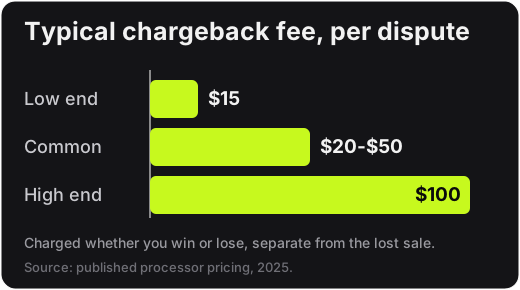
A chargeback fee is the flat, per-dispute charge your processor or acquiring bank adds every time a customer disputes a sale. It is separate from the sale itself. If a cardholder disputes a $200 order, you can lose the $200 and pay the fee on top, and here is the part that surprises most merchants. You pay that fee even when you win the dispute. Processors commonly charge $15 to $100 for each one, and for a high-risk business that number tends to sit near the top of the range, not the bottom.
Key takeaways
- A chargeback fee is a flat per-dispute charge from your processor, typically $15 to $100, separate from the disputed sale amount.
- You pay the fee whether you win or lose the dispute, because it covers handling the case, not the outcome.
- Once you add the lost product, the lost payment, and staff time, US merchants lose about $4.61 for every $1 of fraud (LexisNexis Risk Solutions, 2025).
- Fees and reserves climb as you approach the card networks’ monitoring thresholds, so prevention is what keeps your costs down.
What exactly is a chargeback fee?
A chargeback fee is a fixed administrative charge your payment processor or acquiring bank applies when a cardholder files a dispute against one of your transactions. It is not a percentage of the sale. It is a flat amount, set in your processing agreement, that lands on your account the moment a dispute is opened. Processors commonly charge somewhere between $15 to $100 per dispute, with many landing in the $20 to $50 band.
Think of it as a service charge for the dispute process itself. When a customer goes to their bank instead of coming to you, that bank opens a case on the card networks’ dispute rails, complete with a reason code and a response deadline. Your processor has to handle that case, and the fee is what they bill you for the handling. It exists whether the dispute is legitimate, mistaken, or outright fraudulent.
Why do you pay the fee even when you win?
You pay the chargeback fee even when you win because the fee covers the work of processing the dispute, not the verdict. It is charged at the moment the case is filed, long before anyone decides who is right. Winning the dispute returns the disputed sale amount to your account. The flat per-dispute fee, often $15 to $100, usually stays gone.
This is the detail that trips people up. A merchant assumes that fighting and winning makes them whole. It does not. You recover the sale, but the cost of the fight, the fee and the hours spent assembling evidence, is yours to keep. So even a dispute you are certain you will win still carries a real price tag. That is why writing off a small, clearly losing dispute is sometimes cheaper than contesting it, and why a structured approach to which cases you fight, the kind of judgment that chargeback management is built around, pays for itself.
How does the fee stack with everything else you lose?
The fee is rarely the largest line on the bill, because a chargeback hits you in several places at once. In its 2025 True Cost of Fraud study, LexisNexis Risk Solutions found that US ecommerce and retail merchants lose about $4.61 for every $1 of fraud once fees, lost merchandise, and labor are all counted. The headline fee is just one of those layers.
Here is what a single disputed order can actually cost you:
- The disputed amount. The bank pulls the sale value back out of your account.
- The product. If you already shipped, the goods are gone too, with no return.
- The chargeback fee. The flat $15 to $100 per-dispute charge, owed regardless of outcome.
- The labor. The staff hours spent gathering receipts, tracking numbers, and evidence to respond.
- The ratio cost. Every filed dispute nudges your chargeback ratio up, and that ratio is what decides whether your fees and reserves rise later.
Stack those together and an $80 order can cost several times its value to lose. A refund, by contrast, costs you one thing, the sale. What you pay to process and to dispute is part of your overall high-risk pricing, which is exactly why an honest quote starts from your real dispute numbers rather than a generic rate card.
How is the fee different from the disputed amount?
The chargeback fee and the disputed amount are two separate charges, and confusing them leads to undercounting what a dispute really costs. The disputed amount is the sale value itself, the money the issuing bank claws back and hands to the cardholder. The fee is a flat administrative charge layered on top of that reversal. One is the price of the lost transaction. The other is the price of the dispute existing at all.
A quick example makes the gap clear. A customer disputes a $200 purchase. The bank reverses the $200, so that leaves your account. Your processor then adds, say, a $25 chargeback fee. If you shipped a product, that cost is gone too. You are now down well past $225 on a single $200 sale, before you have spent a minute responding. Win the dispute and the $200 comes back. The $25 fee, in almost every case, does not.
Why do high-risk merchants face higher fees?
High-risk merchants pay higher chargeback fees because processors price for the risk they take on, and a high-dispute business is simply more expensive to bank. If your industry sees more disputes, or your account already runs close to the card networks’ attention, the per-dispute fee sits at the top of that $15 to $100 range, and reserves often come with it.
The pressure gets worse as you approach the monitoring thresholds the networks enforce. In June 2025 Visa folded its older fraud and dispute programs into a single Visa Acquirer Monitoring Program, with the excessive-merchant line now at a 1.5% ratio paired with at least 1,500 monthly events, lowered from 2.2% in April 2026 (Visa, VAMP Fact Sheet, 2025). Mastercard runs a parallel Excessive Chargeback Merchant program that starts at 100 to 299 disputes a month with a 1.5% to 2.99% ratio (Mastercard rules, as published by Stripe, 2025). The closer you drift to those lines, the more a processor charges to keep you, and the harder a single extra fee bites. And these are not edge cases that are fading away. Mastercard projects global chargeback volume climbing from 261 million in 2025 to 324 million by 2028 (Mastercard, 2025 Global Chargebacks Outlook).
How can you reduce what you pay in chargeback fees?
The most reliable way to cut chargeback fees is to cut the disputes that trigger them, because the fee is unavoidable once a case is filed. You cannot negotiate the fee away after the fact. You can stop the dispute from happening. That falls into three moves, and the difference between a refund and a chargeback is worth understanding before you choose, which is the subject of how a chargeback differs from a refund.
- Prevent. Clear billing descriptors, fast customer service, accurate product descriptions, and easy returns stop the complaints that become disputes in the first place.
- Refund early. When a charge is a plain satisfaction issue you would lose anyway, issuing a refund before a chargeback is filed keeps the case, and its fee, off your account entirely.
- Use alerts. Visa and Mastercard operate alert networks (Verifi and Ethoca) that flag a brewing dispute so you can resolve it directly before it converts into a chargeback and its fee.
Every dispute you head off is a fee you never pay, plus a ratio you keep low, which in turn keeps your future fees from climbing. Is it worth chasing a $25 fee? On its own, maybe not. Across hundreds of orders a year, and with your account standing on the line, it adds up fast.
What the chargeback fee really means for your account
The chargeback fee is small next to the rest of what a dispute costs, but it is the clearest signal of a larger truth. A chargeback is never just the lost sale. It is the sale, the product, the fee you owe no matter what, the labor, and a quiet tick on the ratio that governs your account’s survival. For a low-risk shop, that is a line-item annoyance. For a high-risk merchant running near the networks’ thresholds, it is a number worth defending. Keep disputes rare, catch them early, and remember that every fee you avoid is money saved now and a healthier account later.
Frequently asked questions
- What is a chargeback fee?
- It is a flat per-dispute fee your processor or acquirer charges when a cardholder disputes a sale. Processors commonly charge $15 to $100 per dispute, and you owe it whether you win or lose. It is separate from the disputed amount you may also lose.
- Do you pay the chargeback fee even if you win?
- Yes. The fee covers the cost of handling the dispute, so it is charged when the case is filed, not when it is decided. Winning returns the disputed sale amount to you, but the per-dispute fee itself, often $15 to $100, is rarely refunded.
- Is the chargeback fee the same as the disputed amount?
- No. The disputed amount is the sale value the bank pulls back. The fee is a separate flat charge on top, usually $15 to $100 per dispute. On a $200 order you can lose the $200 plus the product plus the fee, all at once.
- Why do high-risk merchants pay higher chargeback fees?
- Processors price for risk. A merchant in a high-dispute category, or one running near the card networks' monitoring thresholds, represents more exposure, so per-dispute fees and reserves tend to sit at the top of the range rather than the bottom.
- How can I lower what I pay in chargeback fees?
- Prevent disputes before they happen, refund clear satisfaction cases before a chargeback is filed, and use Visa and Mastercard alert networks to catch brewing disputes early. Fewer filed disputes means fewer fees and a lower ratio that keeps fees from climbing.